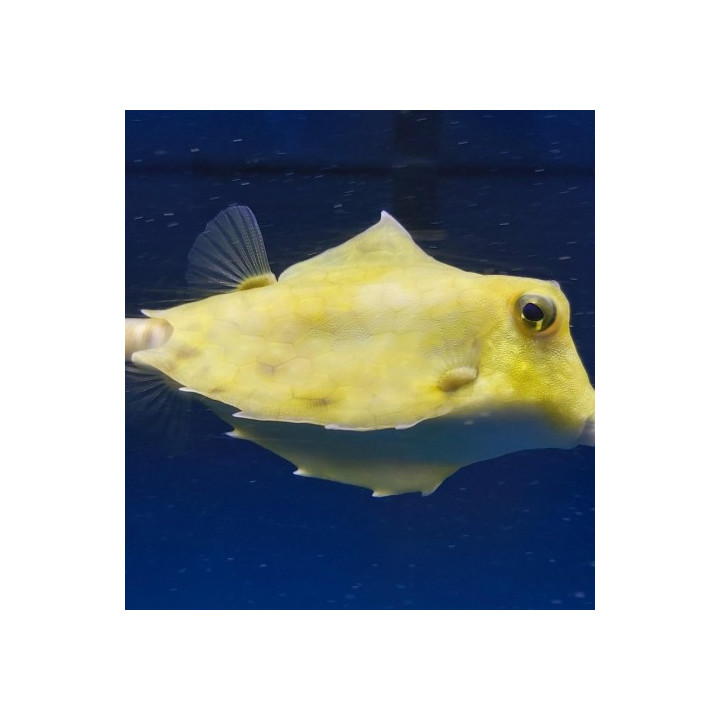
Tetrasomus gibbosus - Hovercraft Cowfish images
Tetrasomus gibbosus - Hovercraft Cowfish
Price:
€98.00
Tax included
Tetrosomus gibbosus, commonly known as the Hovercraft Cowfish or Humpback Turretfish, is an unusually shaped boxfish with a triangular armoured body, prominent dorsal hump and distinctive hovering swimming style. Adults commonly reach around 20 cm and may grow to approximately 30 cm. This demanding species requires a large, peaceful and fully established fish-only marine aquarium. It is not recommended for reef aquariums and may release toxic ostracitoxin when severely stressed, injured or dying.
The Hovercraft Cowfish belongs to the boxfish family Ostraciidae. Most of its body is enclosed inside a rigid carapace formed from fused bony plates. The eyes, mouth, gills and fins extend through openings in the protective structure.
Its movement is produced mainly by the pectoral, dorsal and anal fins, creating the controlled hovering motion responsible for the common name.
Key features
- Distinctive armoured marine boxfish
- Scientific name: Tetrosomus gibbosus
- Common name: Hovercraft Cowfish
- Also known as Humpback Turretfish and Camel Cowfish
- Triangular body profile
- Prominent dorsal hump
- Controlled hovering swimming style
- Bright yellow or orange when young
- Adult coloration becomes more subdued
- Adult size commonly around 20 cm
- Maximum size approximately 30 cm
- Generally peaceful but demanding
- Omnivorous diet
- Requires several small meals daily
- Not recommended for reef aquariums
- May consume corals and invertebrates
- May release ostracitoxin when severely stressed
- Requires a large, established marine aquarium
- Recommended only for experienced marine aquarists
Care information
- Adult size: commonly around 20 cm, up to approximately 30 cm
- Diet: omnivore
- Temperament: peaceful and generally solitary
- Reef compatibility: not recommended
- Care level: advanced
- Origin: Indo-West Pacific
- Natural habitat: muddy and sandy bottoms, seagrass beds and reef margins
Suggested water conditions
- Temperature: approximately 23–27 °C
- Specific gravity: approximately 1.020–1.025
- pH: approximately 8.1–8.4
- Alkalinity: approximately 8–12 dKH
- Ammonia: 0 mg/l
- Nitrite: 0 mg/l
- Flow: low to moderate
- Oxygenation: high
Recommended aquarium
- Long-term minimum volume: approximately 500–600 litres
- Larger aquarium preferred for a full-grown specimen
- Extensive open swimming area
- Broad turning space
- Sand or fine-gravel substrate
- Rounded, stable rockwork
- Low- and moderate-flow areas
- Powerful biological filtration and protein skimming
- Fresh activated carbon available for emergencies
- Keep only one cowfish or closely related boxfish per aquarium
Feeding
Offer a varied diet including:
- Mysis shrimp
- Enriched brine shrimp
- Chopped shrimp
- Mussel
- Krill
- Squid
- Marine algae
- Spirulina foods
- High-quality sinking marine pellets
- Food paste attached to rock or aquarium glass
Feed approximately three small meals daily. Avoid floating foods because the fish may swallow air and develop buoyancy problems.
Toxin emergency
If the fish is severely injured, dies or is suspected of releasing toxin:
- Remove the fish immediately.
- Perform a large water change.
- Add fresh activated carbon.
- Increase protein skimming and aeration.
- Transfer other fish to clean seawater if necessary.
- Monitor all livestock for rapid breathing or abnormal swimming.
- Replace the activated carbon again after a short treatment period.
- Do not handle a dead specimen with bare hands.
-
ReferenceMF0983
-
Reef safeEi
-
Aikuiskoko(cm)30
-
RavintoKasvissyöjä
 Suojauskäytännöt
(muokkaa moduulissa Asiakkaan vakuuttaminen)
 Toimituskäytäntö
Fast shipping
 Palautuskäytäntö
Warranty quaranteed
12 other products in the same category

Pomacanthus imperator - Keisarikala - nuoren väritys
€117.00
Rated out of 5 stars based on
review(s)

Valenciennea strigata - Blue Cheek Goby - West Ind Ocean - pariskunta
€176.00
Rated out of 5 stars based on
review(s)
Comments (0)
Your review appreciation cannot be sent
Report comment
Report sent
Your report cannot be sent