
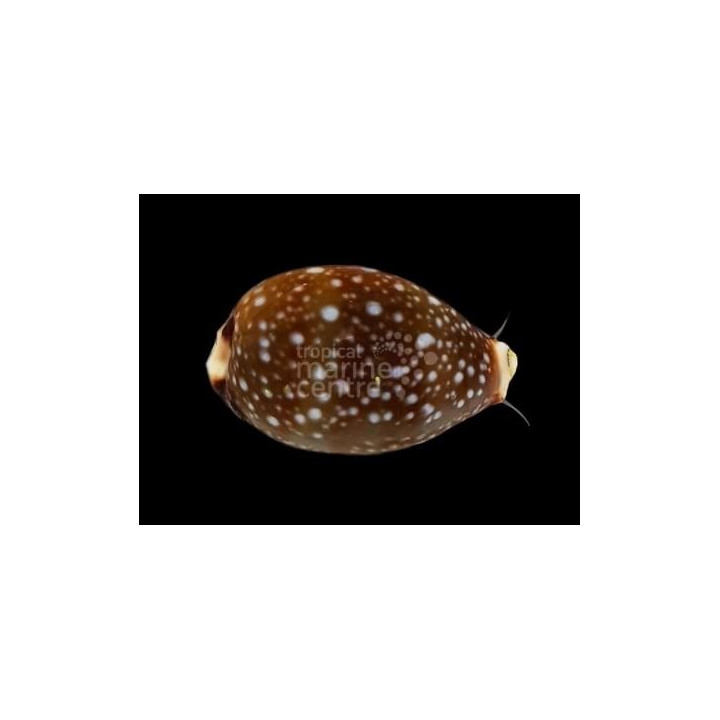
Neobernaya spadicea - Chestnut Cowrie images
Neobernaya spadicea - Chestnut Cowrie
Price:
€28.00
Tax included
Neobernaya spadicea, commonly known as the Chestnut Cowrie, is a striking eastern-Pacific marine snail with a highly polished shell marked by a large chestnut-brown patch, dark border and pale sides. The animal is mainly active at dusk and during the night and often covers its shell with a spotted mantle. This species is an opportunistic predator and scavenger that may consume sponges, tunicates, anemones, gastropod eggs and other organic material. It should therefore not be marketed as a completely reef-safe algae snail. The Chestnut Cowrie is best suited to a mature cool-water or temperate marine aquarium.
The Chestnut Cowrie has a smooth, oval shell measuring approximately 4–6.5 cm in adulthood. The dorsal surface carries a large irregular chestnut-brown patch, while the sides and underside are white or pale bluish white.
When active, the animal extends an orange-brown, dark-spotted mantle over the shell. The mantle cleans the shell and deposits the polished outer layer responsible for its characteristic shine.
Key features
- Distinctive chestnut-coloured cowrie
- Scientific name: Neobernaya spadicea
- Former name: Cypraea spadicea
- Native to the eastern Pacific
- Temperate rather than tropical species
- Highly polished white and chestnut-brown shell
- Orange-brown spotted mantle
- Mantle may cover the complete shell
- Primarily nocturnal
- Shelters beneath rocks during the day
- Opportunistic predator and scavenger
- May also consume biofilm and algae
- May eat sponges, tunicates and anemones
- May consume eggs of other invertebrates
- Reef safe only with caution
- Adult size: approximately 4–6.5 cm
- Requires an established marine aquarium
- Sensitive to copper-based medications
- Recommended for experienced marine aquarists
Care information
- Family: Cypraeidae
- Diet: opportunistic omnivore, predator and scavenger
- Activity: primarily nocturnal
- Temperament: peaceful
- Reef compatibility: with caution
- Care level: intermediate to advanced
- Origin: California and Baja California
- Habitat: rocky shores, crevices and kelp environments
Suggested water conditions
- Temperature: approximately 16–22 °C
- Specific gravity: approximately 1.023–1.026
- pH: approximately 8.0–8.4
- Alkalinity: approximately 7–11 dKH
- Calcium: approximately 400–450 mg/l
- Magnesium: approximately 1,250–1,400 mg/l
- Ammonia: 0 mg/l
- Nitrite: 0 mg/l
- Flow: moderate
- Oxygenation: high
Confirm the holding temperature of the individual before introduction. Do not transfer a cool-water specimen directly into a warm tropical reef aquarium.
Feeding
Offer a varied selection of:
- Chopped mussel
- Shrimp meat
- Mysis shrimp
- Small pieces of marine fish
- Sinking carnivore pellets
- Mixed algae-and-protein wafers
- Dried marine algae
- Mature biofilm-covered rock
Feed after the aquarium lighting dims. Remove uneaten food the following morning.
Introduction
- Confirm the current holding temperature and salinity.
- Ensure the destination aquarium is sufficiently cool.
- Dim the aquarium lighting.
- Equalise the transport-water temperature.
- Acclimate slowly to salinity and water chemistry.
- Do not pull the animal from the transport container.
- Transfer it underwater with its substrate or a small container.
- Place it onto stable sheltered rockwork.
- Confirm that the muscular foot attaches securely.
- Observe the animal after the aquarium lights switch off.
- Protect exposed pump intakes.
- Avoid all copper-based medications.
-
ReferenceINT0239
 Suojauskäytännöt
(muokkaa moduulissa Asiakkaan vakuuttaminen)
 Toimituskäytäntö
Fast shipping
 Palautuskäytäntö
Warranty quaranteed
12 other products in the same category

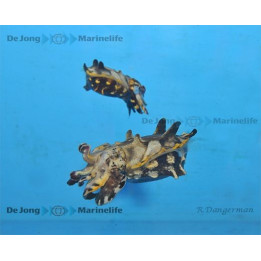
Metasepla pfefferi - Flambuoyant Cuttlefish - pariskunta
€1,774.00
Rated out of 5 stars based on
review(s)

Viewed products

Comments (0)
Your review appreciation cannot be sent
Report comment
Report sent
Your report cannot be sent