
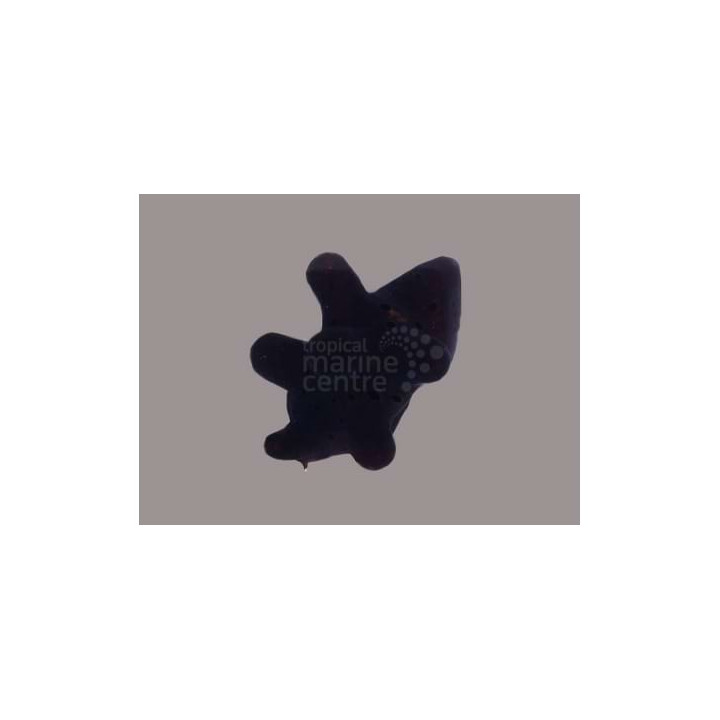
Coriocella hibaye - Quazimodo Slug images
Coriocella hibaye - Quazimodo Slug
Price:
€45.00
Tax included
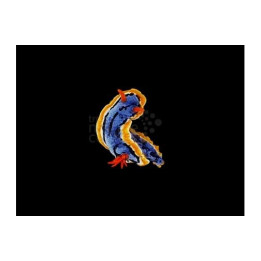
Coriocella hibyae, commonly known as the Quazimodo Slug, is a rare marine snail with a soft, velvety mantle and an unusual humped appearance. Unlike a true nudibranch, the animal has a thin internal shell completely concealed beneath the mantle. Five finger-like dorsal projections, dark blue-grey or brown coloration and small black spots help the animal resemble a sponge. The species is primarily a specialised sponge feeder and is recommended only for highly experienced marine aquarists able to provide a continuous supply of the correct food sponge.
Coriocella hibyae belongs to the family Velutinidae. Its fragile ear-shaped shell remains hidden inside the thick mantle, giving the animal the external appearance of a shell-less sea slug.
The species is known from the western Indian Ocean, particularly the Maldives. Its sponge-like form provides effective camouflage among reef rubble, shaded rock surfaces and natural sponge growth.
Key features
- Rare velvety marine snail
- Correct scientific name: Coriocella hibyae
- Sometimes misspelled as Coriocella hibaye
- Common name: Quazimodo Slug
- Also known as Hiby’s Coriocella and Velvet Snail
- Family: Velutinidae
- Thin internal shell concealed beneath the mantle
- Five finger-like dorsal projections
- Dark blue-grey, brown or nearly black body
- Small dark spots
- Sponge-like camouflage
- Native to the western Indian Ocean
- Maximum size approximately 10 cm
- Completely peaceful
- Specialised sponge feeder
- Does not graze algae
- Does not reliably accept ordinary aquarium foods
- Reef safe only with caution
- May consume ornamental sponges
- Requires a continuous supply of the correct sponge
- Sensitive to copper and medications
- Must be protected from pumps and overflows
- Recommended only for experienced marine aquarists
Care information
- Adult size: up to approximately 10 cm
- Diet: selected sponge species
- Activity: commonly active at dusk and during the night
- Temperament: peaceful
- Reef compatibility: with caution
- Care level: extremely difficult
- Origin: western Indian Ocean, particularly the Maldives
- Natural habitat: reef rubble, rocky surfaces and sponge-rich areas
- Recommended minimum aquarium volume: approximately 150 litres
Suggested water conditions
- Temperature: approximately 23–27 °C
- Specific gravity: approximately 1.024–1.026
- pH: approximately 8.1–8.4
- Alkalinity: approximately 8–12 dKH
- Ammonia: 0 mg/l
- Nitrite: 0 mg/l
- Flow: moderate and indirect
- Lighting: low to moderate
- Oxygenation: high
Feeding
Identify the exact sponge consumed by the individual before purchase. Maintain a continuous supply of the same sponge and replace the food source before the available growth is completely consumed.
Ordinary fish foods, frozen foods, coral powders, phytoplankton, zooplankton and algae sheets do not reliably replace the natural food sponge.
Introduction
- Confirm that the correct food sponge is available.
- Protect all pump and overflow intakes.
- Dim the aquarium lighting.
- Equalise the transport-water temperature.
- Acclimate gradually to salinity and water chemistry.
- Avoid unnecessary exposure to air.
- Do not handle the animal with bare hands.
- Transfer it underwater in a small container.
- Place it directly beside the identified food sponge.
- Temporarily reduce strong water flow.
- Confirm that the muscular foot attaches securely.
- Monitor feeding, movement and body condition closely.
- Avoid all copper-based medications.
-
ReferenceINT0271
 Suojauskäytännöt
(muokkaa moduulissa Asiakkaan vakuuttaminen)
 Toimituskäytäntö
Fast shipping
 Palautuskäytäntö
Warranty quaranteed
12 other products in the same category



Comments (0)
Your review appreciation cannot be sent
Report comment
Report sent
Your report cannot be sent