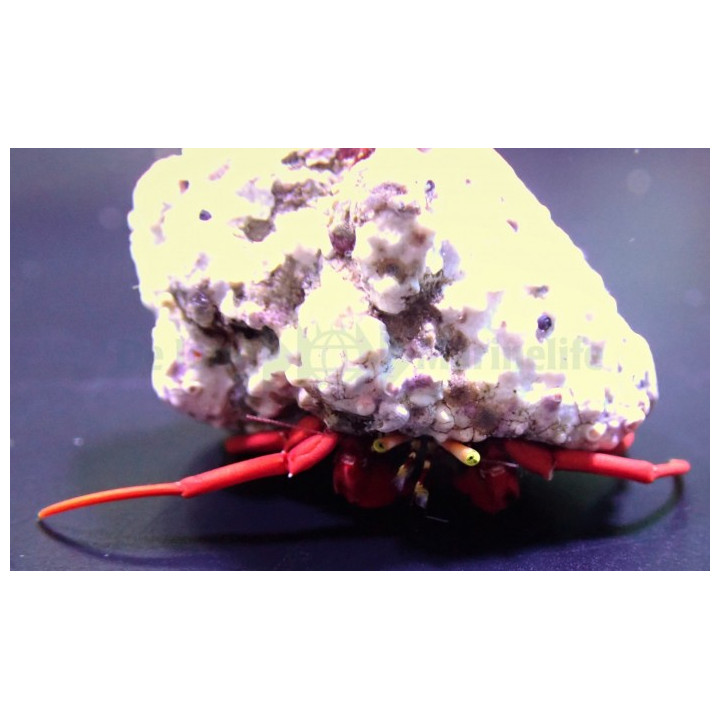
Paguristes cadenati images
Paguristes cadenati
Price:
€12.00
Tax included
Paguristes cadenati, commonly known as the Scarlet Reef Hermit Crab, is a small, brightly coloured clean-up-crew crustacean for established marine and reef aquariums. The crab grazes microalgae and biofilm while consuming detritus, leftover food and other organic material. It is generally peaceful and reef safe, but several correctly sized empty replacement shells must always be available. A shortage of food or shells may lead to aggression toward other hermit crabs or living snails.
The Scarlet Reef Hermit Crab is recognised by its vivid red legs, yellowish face and pale antennae. The species originates from the Caribbean and tropical western Atlantic, where it occurs around shallow reefs, rubble fields and seagrass habitats.
The crab moves across rockwork and sandy substrate, picking up algae, detritus and edible particles with its claws. Its small size allows it to clean narrow crevices that larger snails and grazing animals cannot reach.
Key features
- Bright-red marine hermit crab
- Scientific name: Paguristes cadenati
- Common name: Scarlet Reef Hermit Crab
- Native to the Caribbean and western Atlantic
- Red legs and yellowish face
- Small adult size
- Generally peaceful
- Omnivorous scavenger
- Grazes microalgae and biofilm
- Consumes detritus and leftover food
- Useful member of a marine clean-up crew
- Generally reef safe
- Does not normally consume healthy corals
- May overturn unsecured coral fragments
- Requires several empty replacement shells
- May attack snails if suitable empty shells are unavailable
- Sensitive to copper-based medications
- Suitable for beginning marine aquarists
Care information
- Family: Diogenidae
- Adult size: approximately 2.5–4 cm excluding the shell
- Diet: algae, biofilm, detritus, leftover food and supplemental plant- and animal-based foods
- Temperament: generally peaceful
- Reef compatibility: reef safe with normal caution
- Care level: easy
- Origin: Caribbean and tropical western Atlantic
- Recommended minimum aquarium volume: approximately 40–50 litres
- Special requirement: multiple empty replacement shells
Suggested water conditions
- Temperature: approximately 22–26 °C
- Specific gravity: approximately 1.023–1.026
- pH: approximately 8.1–8.4
- Alkalinity: approximately 8–12 dKH
- Calcium: approximately 400–450 mg/l
- Magnesium: approximately 1,250–1,400 mg/l
- Ammonia: 0 mg/l
- Nitrite: 0 mg/l
- Flow: low to moderate
Feeding
In an established aquarium, the crab obtains much of its food from natural algae, biofilm, detritus and leftovers. Supplement exceptionally clean systems with:
- Spirulina-based sinking tablets
- Algae-based pellets
- Dried nori
- Mysis shrimp
- Brine shrimp
- Chopped krill
- Small pieces of mussel
- Complete sinking crustacean pellets
Feed small portions and remove uneaten food before it decomposes.
Replacement shells
Provide at least three to five suitable empty shells per crab:
- Offer several shapes and opening widths.
- Include shells slightly larger than the one currently occupied.
- Add larger alternatives as the crab grows.
- Use clean, untreated natural marine shells.
- Avoid painted, lacquered or chemically treated decorative shells.
Adequate shell availability significantly reduces competition and attacks on living snails.
-
ReferenceINT0005
-
In stock46 Items
 Suojauskäytännöt
(muokkaa moduulissa Asiakkaan vakuuttaminen)
 Toimituskäytäntö
Fast shipping
 Palautuskäytäntö
Warranty quaranteed
12 other products in the same category




Comments (0)
Your review appreciation cannot be sent
Report comment
Report sent
Your report cannot be sent